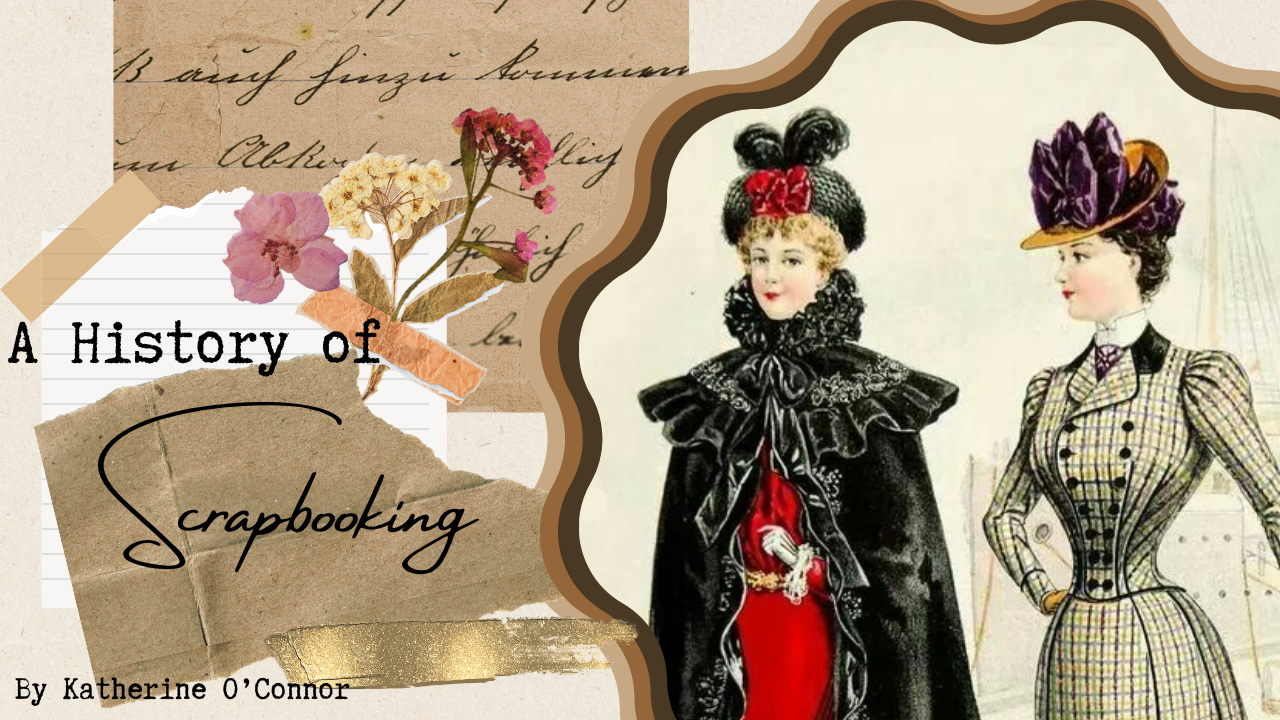
When we think of scrapbooking, our minds may immediately go to a ribbon-lined world of craft scissors and glitter glue. However, the hobby's history is much deeper than even the age of physical images. Dating as far back as the 1400s, families would record personal details and histories in the margins of their Bibles, acting less as annotations and more as documentation. It was a way to pass down wedding dates, family traditions, and even hold keepsakes, like the locks of a child's hair (Scrapbooking).
Following the invention of the printing press, permanent and more legible writing became accessible. The scrapbooking process shifted with this, people instead opting to tuck these records between the pages of their Bibles.
The 19th century, a time outlined by what some historians call “The Victorian scrapbook craze,” showed a spike in the creative hobby (Journal of Antiques). As society began requiring women to learn to read, play music, and master art in order to be accomplished, they accidentally opened the door for women to express themselves creatively.
Young women, in particular, began creating albums containing watercolors, poetry, and mementos from friends. Even in a time where women in the upper middle class were only deemed valuable in the marriage market if their skill set was impressive enough, testimonials of female friendships prevailed. Using art as a way to express your love for others is evidently timeless; you can walk through any museum and conclude as much. However, taking a practice that was strictly introduced for courtship purposes, and instead choosing to create something personal for your friends is a piece of history that should perhaps be highlighted more.
During the Civil War, scrapbooking became not just a way to express oneself, but also a means to document injustice. In 1974, Nobel Peace Prize winner Toni Morrison created “The Black Book”, a compilation of bills of sale for slaves and runaway ads (National Endowment for the Humanities). It’s a collection of frightening historical snippets, a disturbing anthology that now stands as a piece of evidence: a scrapbook.
What has been emerging across centuries is not just a hobby, but a pattern. I think there is an almost instinctual need to hold onto something before it slips away, and in some instances it was absolutely vital to shining a light on the truth. Whether preserving love, friendship, identity, or injustice, scrapbooking has long existed to document personal experiences.
However, I think this need for visibility has since gone from crucial to futile.
In the modern age, you no longer need to be particularly talented or unique to have a video receive millions of views, nor will you even be recognized by the average person if you have 100,000 followers on social media.
Despite our innate inventiveness, I think there is an even more overwhelming fear that who we are, and what we are experiencing, will simply not be remembered.
After COVID-19, I observed a resurgence in physical media. Shopping secondhand became trendy instead of embarrassing, and vintage finds (like the oh-so-archaic iPod nano) became quirky thrifts. Crocheting supplies spiked, and suddenly, saving a pin on your Pinterest board was no longer enough to satiate the ever-growing need to be ‘aesthetic’.
Today, the scrapbook has been rebranded into the junk journal.
A less organized progression of the ever-changing scrapbook, the junk journal is a hoarder's dream. Individuals online have taken to turning everything into a keepsake, even including your coffee-stained napkin that will now live forevermore in a notebook that is bursting at the seams.
Junk journals don’t require a plan, instead forming themselves through the scraps we accumulate through everyday life.
“People have referred to it as a relaxing form of self-care, and a hobby to improve the creativity that’s been absolutely crushed to death by scrolling” (Rolling Stone). But I can’t help but wonder if the junk journal is just another form of overconsumption.
While scrapbooking has proven to be a more female-dominated hobby throughout history, I find the innate desire to document our lives to be something deeply human.
The craft has historically given anyone the opportunity to become an archivist. A historian. It has turned young fashion lovers into designers through the cut-up pieces of a Vogue magazine. It has given a voice to those whose history has been systematically oppressed. Junk journaling, despite my reservations, has now turned even your smallest moments into a physical memento.
In a world that has moved so vehemently away from physical media, I think people now yearn for documentation in an almost desperate way.
While junk journaling may just be the next fad in the endless trend cycle, it reduces waste, acts as a form of physical media, and is a way to commemorate your way of life.
While I desperately hope that one day we can move past the need to be viewed as important or desirable by strangers online, there is nothing , in truth, more human than wanting to say: “I was here.”
Written by: Katherine O’Connor
Cover Design by: Katherine O’Connor